|
|
| Tuesday, November 21, 2023 10:49 PM |
| (Last updated on Tuesday, November 21, 2023 10:51 PM) | | Behold! An Update! |
 by Fëanor by Fëanor |
Hello, folks! A couple of things. First, Twitter is now X, and X is garbage and run by a garbage human being, so I decided to remove all integrations with Twitter/X from my site. No more Twitter sidebar on the blog, no more links to my Twitter account, no more tweet buttons, etc. If you find a button or link to Twitter/X somewhere on the site, please let me know and I'll get rid of it. Thank you!
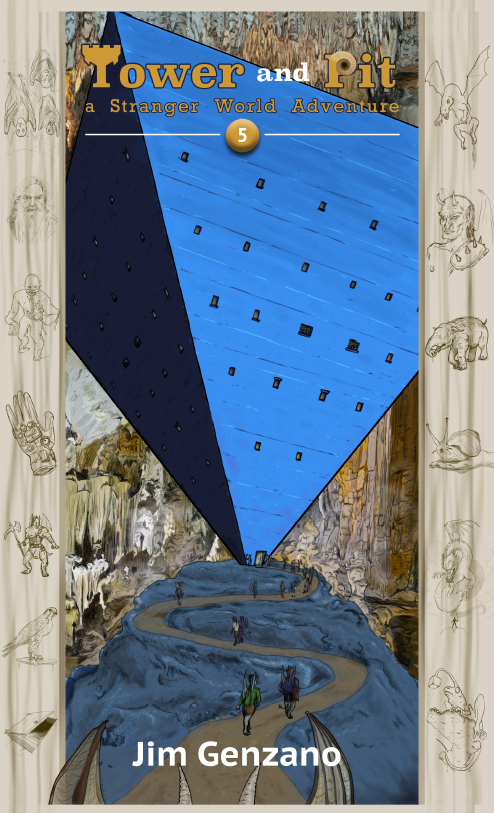
Second, my latest book - TOWER AND PIT: A STRANGER WORLD ADVENTURE - is coming out in paperback and ebook! It's the latest in my fantasy series about a boy named Hunter exploring a magical world and trying to solve its mysteries while hopefully avoiding being killed by any of its monsters. You can pre-order the book now most places (check the Published Works section for links and info), or you can wait and buy it when it gets released on Cyber Monday, November 27. Or, if you really don't like the idea of paying for things, you can enter the giveaway on Goodreads and maybe win a free copy! The giveaway ends on December 10, though, so hurry.
Okay, I think that's everything for now. Thanks for reading! |
|
|
|
|
| Tuesday, June 6, 2023 10:36 AM |
| A Wizard, Demons, Snails, Zombies (Sort of), and Time Travel (Sort of) |
| by Fëanor |
Hey, my new book is out! It's the fifth entry in the Stranger World series and it's called Tower and Pit. The title of this post gives you an idea what to expect from it. It's the creepiest entry in the series yet, and I think a pretty fun read. I hope you'll agree. Currently it's available in hardcover at Amazon and Barnes & Noble. December of this year I'll be putting it out in ebook and paperback. As always, you can find links to every edition of all my books over in the Published Works section of my site.
|
|
|
|
|
| Thursday, June 9, 2022 03:31 PM |
| It's that time again |
| by Fëanor |
I made you another STRANGER WORLD book! This one is called BOOK AND HALL and you can pre-order it now on Barnes & Noble. It will be officially released on June 27, 2022, when it will also be available on Amazon.com.
This is the hardcover edition, by the way. The paperback and eBook editions will follow either late this year or early next year. I'll certainly let you know!
This particular entry in the Stranger World series is a pretty fun one I think. The main setting for the story is a maze-like museum full of creepy and fascinating magical artifacts, overseen by a mysterious collector and his grumpy bear butler. There's also a winged horse, a squad of werewolves, and the return of two recurring characters: the Puzzle Piece Man and Esthuan Thievesbane.
I'm sorry to say this book also features the final appearance in the series of Hunter's best friends, Gertrude Clemmons and David Kim. My first draft of the Stranger World story was one enormous novel, and in that version, Gert had even fewer scenes, and David had almost none. When I decided to split the book into six parts, and it came time to flesh out this section of the story, I made it a priority to give Gert and David more space, because I really enjoyed the dynamic between Hunter and his friends. Also, with the story split into separate books, I needed to find ways to remind you of what happened last time at the beginning of each book. I found a way to combine both those purposes with this book's opening scene.
It was also breaking the story up, and then needing to flesh out the separate parts into their own books, that gave birth to the character of Esthuan Thievesbane, who ended up being one of my favorite things about the story. She gets a chance to shine again here.
Anyway, I hope you like the book, and thanks for reading! |
|
|
|
|
| Sunday, March 6, 2022 10:34 AM |
| You Get a Book! And You Get a Book! |
 by Fëanor by Fëanor |
Hi, folks! Just popping on to mention that you can now purchase my latest book, RING AND IRON: A STRANGER WORLD ADVENTURE, in paperback format on Amazon!
It wasn't supposed to come out until tomorrow, but Amazon is weird about paperbacks and doesn't let you put them on presale or set exactly when they're going to be published; you just have to push the button a little before they're supposed to be available and hope for the best. So you get it a day early! It'll be officially released in paperback and eBook everywhere else tomorrow.
I'm afraid the Amazon paperback edition of RING AND IRON is a bit more expensive than the previous volumes in the series, and I'm honestly not entirely sure why. It's a bit longer, mostly because I increased the font size, so that might be it. But it's also possible that production costs have just gone up.
The good news is, if paying for books is not your thing, I've still got you covered! Now until the end of March, you can enter a giveaway for a FREE copy of the Kindle eBook edition of RING AND IRON on Goodreads! A lot of people have already entered, so better get on it if you want your chance.
I've said it before, but RING AND IRON really is my best book yet, and it catches you up on the story so far, so if you've been avoiding the series until now, I hope you'll give this one a try.
Regardless, as always, thanks for reading! |
|
|
|
|
| Tuesday, November 2, 2021 08:46 AM |
| Do you like free stuff? |
 by Fëanor by Fëanor |
If you're curious about my books, but aren't sure you want to spend money to find out if they're any good, I have good news for you! I'm giving away my latest book, RING AND IRON: A STRANGER WORLD ADVENTURE! There are separate giveaways running now on Facebook and Twitter. It's easy to enter, and if you win, I'll send you a free signed hardcover copy of the book! Just get in there soon, because I'll pick the winners in six days, on 11/8/21.
Thanks for reading, and good luck! |
|
|
|
|
| Sunday, October 31, 2021 08:36 AM |
| (Last updated on Sunday, October 31, 2021 08:38 AM) | | My New Book Is Out! |
 by Fëanor by Fëanor |
Hey, I totally jumped the gun and released my new book! BOOM! RING AND IRON: A STRANGER WORLD ADVENTURE is out now!
Wee!
Yeah, I was planning on holding out until 12/6 for the release, and putting it on pre-order tomorrow, but then I was reading about supply chain issues that are effecting the publishing industry, and how book orders later than early November would likely not make it to folks in time for the holidays, and I decided to just pull the trigger. I want you to have it in your hands before the end of the year, so here you go!
If you don't want to buy it on Amazon, you can also pre-order it on Barnes and Noble. It'll come out on that site on 11/14. They wouldn't let me release it any earlier than that for some reason.
Keep in mind, this is the hardcover release; the paperback and eBook versions will come out some time next year.
Because I'm a self-published author, my books survive on "word of mouth," so I would really appreciate it if you would tell folks about RING AND IRON. It's my best book yet. It has magic and adventure and monsters and mystery, and I think it's good fun for all ages, 8 to 1000. Post about it on social media! Review it on Amazon! Tell people about it when you pass them in the street!
Of course, RING AND IRON is even better if you've already read the first two entries in the series, TREE AND BEAST and SEA AND SWORD, but you can start here and not be lost. I do the thing in the beginning where I get you up to speed on the story, don't worry!
Anyway, I hope you all love the book. Thanks for reading! |
|
|
|
|
| Sunday, September 26, 2021 12:41 PM |
| (Last updated on Sunday, September 26, 2021 12:42 PM) | | Let's Talk Some More About Books! |
 by Fëanor by Fëanor |
Hey! I remembered I had a blog, and some things are going on, so I thought I'd post!
- My next book, RING AND IRON: A STRANGER WORLD ADVENTURE, the third entry in my Middle Grade fantasy series, will be out in hardcover on December 6th! Mark your calendars! I'm not sure when I'll put it on pre-sale on Barnes & Noble...probably some time in November? Anyway, I will definitely shout about it when it happens.
- Kirkus Reviews just reviewed the book! You can read it here, and I added a quote from the review to my Published Works page. TL/DR: they liked it! Although apparently they think the kids these days don't know about LORD OF THE RINGS, and might not get my references to it. Well, they should! That's all I have to say about that.
- As I mentioned in my last post, I asked some folks to read the early draft of my next, non-Stranger-World novel, the title of which I haven't decided on yet (currently I like IN THE CITY OF A HUNGRY GOD - what do you think?), and they gave me a lot of useful feedback. One thing I kept thinking about was the complaint that it didn't feel like it had a solid conclusion. I had indeed purposefully left things at a cliffhanger, but the more I thought about it, the more I thought the first book in a series shouldn't end that way. It did need some more satisfying ending, in which our heroes accomplished something more tangible. As I said to my brother, "this one should be A New Hope, not Empire Strikes Back." I thought maybe I could slap together a better ending in maybe 5 or 10 thousand words. Well, 27,000 words later, I was done! Yeah, it's quite a bit longer now, but I'm also much happier with it.
- Still on the topic of the new book: I'd assumed as I was writing it that it would be for the Young Adult audience. But the new word count puts it outside the established range for YA - even for the traditionally longer fantasy genre. I talked to a literary agent friend of mine, describing my problem, and he pointed out that since two of my main characters were adults, what I had wasn't really YA anyway. So yeah, turns out I wrote an adult fantasy book. I guess it's also technically urban fantasy, since most of it takes place in a present day city. Who knew?? Anyway, that's actually good news really, since for adult fantasy, my word count is just right.
- The next step for my new book is for me to do yet another editing pass, making sure it all hangs together and sounds good. Then I'll send it back out to my test readers again for them to do another pass. I'd also like to get a sensitivity reader or two to take a look at it, as I'm dealing with some minority groups here and I don't want to be saying anything stupid by mistake. Then I start searching for a literary agent who's interested in this kind of book. Then I write query letters, send them out, and cross my fingers. I hope you'll cross your fingers for me, too!
- As for stuff I'm reading, I'm currently on the final book in Maggie Stiefvater's Wolves of Mercy Falls series, SINNER. Each book in this series has been better than the last, and this one features a particularly complex relationship between two particularly broken individuals. Interestingly, it's focusing a lot more on real world emotional issues than it is on the werewolf stuff. It's good!
- Other books I've read recently are STORMSONG and SOULSTAR, the last two entries in C.L. Polk's Kingston Cycle (thanks to my friend Cynthia for turning me on to this series; I stalk her Goodreads and add everything she rates highly to my "to read" shelf!). These are also fantasy romance books, like The Wolves of Mercy Falls, but they also each feature a murder mystery, and are set not on a subtly altered present day Earth, but in a completely different reality full of magic, ghosts, and angels. Also, the romances featured are LGBTQ+. The final book has the most complex romance, as there's no meet-cute or passionate first kiss; instead, we follow along as two people who were separated 20 years ago re-learn how to be a couple. It's well done.
|
|
|
|
|
| Friday, July 30, 2021 02:41 PM |
| Books! Wow! |
| by Fëanor |
A couple of updates for all of you fine folks who still check in on my website (bless you, all two of you): I created a page on Goodreads for my new book RING AND IRON: A STRANGER WORLD ADVENTURE, which will be the third entry in my STRANGER WORLD series. I really think this one is my best book yet, and I'm not just saying that. It introduces one of my favorite characters, and features a life-or-death game of Candy Land. Not a lot of authors can claim their book has that! You can add it to your Want to Read shelf on Goodreads, if you'd like. That would be awesome. (There was a bug with those Goodreads buttons on my site, but I fixed it, so should be easy to do now.) The book also now appears in the Goodreads widget over on the side of my blog, and I made a space for it on the Published Works area of my site. The plan is to release this one in hardcover on December 6th, 2021, so mark your calendars! I'll set it up to go on pre-sale on Barnes & Noble by Black Friday/Cyber Monday, so you can order it as a gift for the holidays. (Unfortunately, Amazon does not allow you to put self-published books on pre-sale for some strange reason.) So, everybody's going to order each other copies of my book for Christmas and Hanukkah and Kwanzaa, right? Please??
I've also finished the first draft of a new novel which is the first entry in what I plan to be a YA fantasy trilogy. It's about an alternate history version of America where an evangelical protestant church basically runs the country, magic is real, and witches are outlawed. I sent it off to some family members and am anxiously awaiting their responses. I have to say, I'm a little sad to not have any writing project to work on at the moment. Maybe I should start the next entry in the series...
Meanwhile, I've been obsessed with the work of Maggie Stiefvater lately and have been reading all her stuff. She's pretty amazing. I particularly recommend her Raven Cycle (starting with The Raven Boys), which is followed by the Dreamer Trilogy (still ongoing), and also her standalone book The Scorpio Races which really blew me away. I've just started her YA werewolf romance series, The Wolves of Mercy Falls, which is fun.
Wow, it's been a while since I wrote a post this long on here! Anyway, happy reading everybody. |
|
|
|
|
| Monday, March 1, 2021 09:53 AM |
| For Amazonians Only |
 by Fëanor by Fëanor |
Exciting news! Amazon invited me to a private beta for self-publishing hardcover books, so both my books are now available on Amazon in hardcover format! Their hardcover format is a bit different from the Barnes & Noble format. Barnes & Noble prints the cover illustration on a paper jacket that wraps around the book. Amazon does what they call case laminate hardcover, which means the cover illustration is applied directly to the cover itself, and there is no jacket.
Anyway, here are the links! Thanks for looking.
Tree and Beast
Sea and Sword |
|
|
|
|
|
|




 Jim Genzano's books on Goodreads